
Responsive Web Design for Gulf Businesses: Why It Matters More in Dubai, Riyadh & the GCC Than Anywhere Else

A potential client in Riyadh finds your business on their phone — the device they use for almost everything. Your website loads slowly, the text requires pinching to read, and the contact button sits behind an element that won't move. They close the tab before your page finishes loading. That interaction took under five seconds and cost you a lead you never knew existed.
This scenario plays out thousands of times a day across the Gulf — a region with some of the highest mobile penetration rates on the planet. According to DataReportal's Digital 2026 UAE report, the UAE has 23 million mobile connections — 202% of the total population. In Saudi Arabia, mobile connections stand at 48.7 million — 140% of the population. Responsive web design is not a nice-to-have feature in these markets. It is the baseline requirement for being taken seriously as a business online.
This guide explains what responsive design is, why Gulf markets make it more critical than almost anywhere else, what the Google ranking consequences are for non-responsive sites, the specific Gulf requirements that Western guides ignore, and how to audit whether your current site meets the standard.
What Responsive Web Design Actually Means in 2026
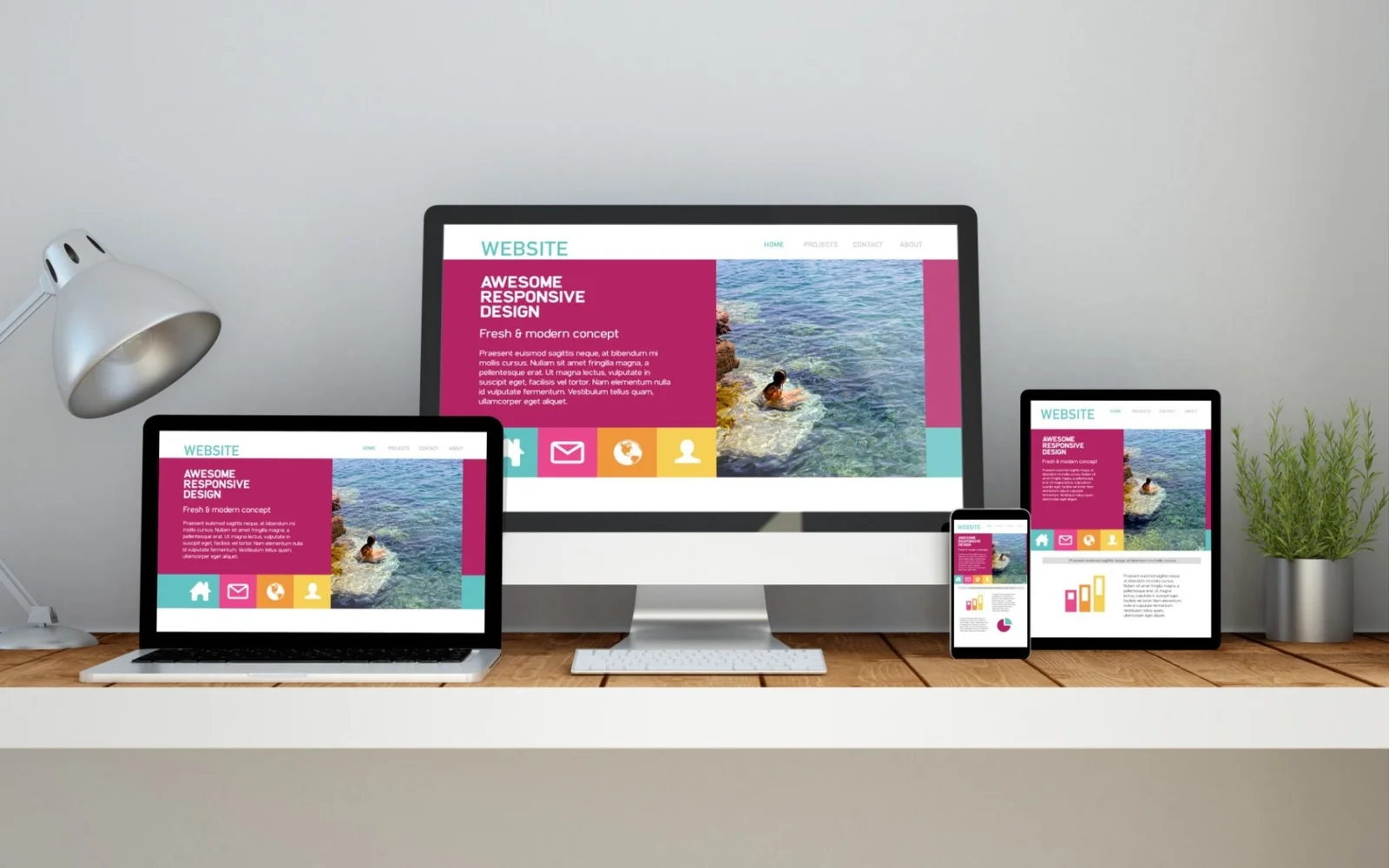
Responsive web design is an approach where a single website dynamically adapts to different screen sizes, orientations, and interaction methods. As Lucidly's 2026 responsive design guide explains, it is built on three core principles:
- Fluid layouts — page elements scale proportionally rather than relying on fixed pixel widths that break on smaller screens.
- Flexible media — images and videos resize within their containers without distortion or overflow, regardless of the screen displaying them.
- CSS breakpoints — layout and spacing adjust based on screen size, so a navigation menu that works beautifully on a 27-inch monitor also works on a 6-inch phone screen.
What responsive design is not: a separate mobile website, an app, or a scaled-down version of a desktop site. It is one codebase that serves every device equally well — and Google indexes it as a single authoritative URL.
In 2026, responsive design has evolved beyond fitting content to screen sizes. According to Skybridge IT's Dubai web design trends report, modern responsive design now encompasses Progressive Web App (PWA) architecture for mobile performance, bilingual RTL-compatible design systems, and AI personalisation layers — all of which must function across the full device spectrum. But the foundational requirement — that your site works on a phone — remains the non-negotiable starting point.
Why Gulf Markets Make Responsive Design More Critical Than Anywhere Else
Responsive design matters everywhere, but Gulf markets combine three factors that make the stakes uniquely high: exceptional mobile infrastructure, extremely demanding mobile users, and Google's unforgiving mobile-first indexing algorithm.
Factor 1: The Gulf Has World-Class Mobile Infrastructure — and Users Who Expect It
The UAE's average mobile internet speed of 441.89 Mbps places it among the global leaders, according to Ookla data via Aletihad. Saudi Arabia's mobile speed of 194.49 Mbps — a 59% increase year-on-year — is also well above the global average, per DataReportal. Both the UAE and Saudi Arabia have the highest 5G adoption in the MENA region.
This creates a paradox that catches Gulf businesses off guard: fast mobile networks produce impatient mobile users. When users have 441 Mbps mobile connections, they expect pages to load in under two seconds. As Mystic Advertising's UAE web design trends report confirms: "UAE users demand loads under two seconds. Slow sites see high bounce rates." A site that would be considered "acceptable" in a market with 20 Mbps mobile speeds is considered broken in Dubai or Abu Dhabi.
Factor 2: Mobile Is the Primary Browsing and Purchase Device
As Viacon Digital's 2026 Dubai web design analysis notes, active smartphone users in the UAE region number 21.9 million — more than the population — and mobile-first browsing extends to product research, business enquiries, real estate searches, and purchasing decisions. When a Riyadh professional searches for a service provider, they are almost certainly doing it on their phone. When a Dubai consumer decides whether a restaurant is worth visiting, they are looking at the restaurant's website on mobile. A non-responsive site in this context does not just underperform — it signals that the business has not invested in its own digital presence.
Factor 3: Google's Mobile-First Indexing Penalises Non-Responsive Sites
Google now primarily uses the mobile version of a website for indexing and ranking — a policy called mobile-first indexing. As Sky SEO Digital confirms, this makes mobile performance the primary determinant of where your site ranks in Google — not your desktop experience. A business in Business Bay or Riyadh's KAFD that invests in a stunning desktop website but neglects mobile will rank lower than a competitor with a simpler but mobile-optimised site — regardless of content quality.
Core Web Vitals: The Metrics That Determine Your Google Ranking
Core Web Vitals are Google's three primary metrics for measuring real-user experience on websites. They are confirmed ranking factors — DebugBear notes that Google uses them as a "tie-breaker between pages with similar content quality." According to ALM Corp's 2026 technical SEO guide, pages ranking at position 1 are 10% more likely to pass Core Web Vitals scores than those at position 9. Beyond SEO, they directly affect business outcomes: research from Deloitte and Google cited by MonsterInsights shows that improving page speed by just 0.1 seconds can boost retail site conversion rates by 8.4% and average order value by 9.2%.
| Metric | What It Measures | Good | Needs Work | Poor | Gulf Priority |
|---|---|---|---|---|---|
| LCP — Largest Contentful Paint | How quickly the main content (hero image, heading) loads | ≤ 2.5s | 2.5–4.0s | > 4.0s | Critical — UAE/Saudi users expect under 2 seconds |
| INP — Interaction to Next Paint | How quickly the page responds to taps, clicks, and inputs | ≤ 200ms | 200–500ms | > 500ms | High — WhatsApp CTAs and mobile forms must respond instantly |
| CLS — Cumulative Layout Shift | How much the page layout shifts unexpectedly during loading | ≤ 0.1 | 0.1–0.25 | > 0.25 | High — layout shifts in bilingual Arabic/English sites are common failure point |
The business impact is documented: Rakuten 24 optimised all three Core Web Vitals and recorded a 53% increase in revenue per visitor and a 33% higher conversion rate. Vodafone improved LCP by 31% and saw an 8% increase in sales. For a Gulf e-commerce business processing AED 5M in annual revenue, a 33% conversion lift represents AED 1.65M in additional sales from the same traffic.
Gulf-Specific Responsive Design Requirements
Standard responsive design guidance — use fluid grids, compress images, test on multiple devices — applies everywhere. But Gulf markets have four additional requirements that no Western responsive design guide addresses, and getting any of them wrong produces a site that is technically responsive but practically broken for your actual audience.
Requirement 1: Bilingual Arabic/English RTL Responsive Layout
Arabic reads right-to-left. A responsive design that works perfectly in English can break completely when switched to Arabic — navigation that was left-aligned now needs to be right-aligned, text that flowed naturally left now flows right, and interface elements like back arrows, dropdown carets, and progress indicators all reverse in meaning. As Mystic Advertising's UAE web design report notes, bilingual interfaces for Arabic and English speakers are standard expectation — "Right-to-left text support is standard for Arabic content." This is not a nice-to-have. A Gulf business targeting Arabic-speaking customers in Dubai, Riyadh, or Abu Dhabi without a functional Arabic RTL mobile experience is handing those customers to competitors.
RTL responsive design requires separate CSS declarations for the Arabic language direction, testing at every CSS breakpoint (not just desktop), and verification of navigation, forms, buttons, tables, and carousels in both languages on actual mobile devices. Native Arabic speaker review before publication is non-negotiable.
Requirement 2: WhatsApp CTA Optimisation on Mobile
WhatsApp is the dominant communication platform across the Gulf — used for business enquiries, customer service, booking confirmations, and follow-ups across every sector. A responsive Gulf business website must include a WhatsApp Click-to-Chat button that is thumb-accessible on mobile, loads the correct country-code-prefixed number, and positions itself where it does not obscure other content. As Mystic Advertising notes, "WhatsApp integration allows quick chats" and is an expected feature of Gulf mobile web design in 2026. A floating WhatsApp button that appears on mobile only — not cluttering the desktop experience — is the standard implementation.
Requirement 3: Thumb-Zone Design for One-Handed Mobile Use
Gulf mobile users predominantly browse one-handed — on commutes, in meetings, in waiting rooms. Mystic Advertising's UAE design report specifically calls out "thumb-friendly elements" that place buttons "within easy reach" and simplify form input on small devices. Primary CTAs (WhatsApp, call now, book appointment, add to cart) must sit in the lower third of the viewport on mobile — within natural thumb reach — rather than at the top or centre of the screen where one-handed interaction is awkward.
Requirement 4: Performance Optimisation for Peak Traffic Periods
Gulf markets have distinct traffic spikes that require specific performance preparation. Ramadan sees dramatically increased evening mobile browsing after Iftar as users shop, browse, and engage with content. Eid sale periods and White Friday create sudden traffic surges for retail sites. Saudi National Day, UAE National Day, and Dubai Shopping Festival generate predictable peaks. A responsive site that performs adequately under normal load must be tested and optimised for these burst periods. Skybridge IT notes that Gulf businesses must prepare for "seasonal eCommerce peaks (Ramadan, White Friday, National Day)" as part of their core performance strategy.
How to Audit Your Current Gulf Website for Responsive Performance
This six-point audit takes under 30 minutes and identifies the most common responsive design failures on Gulf business websites. Work through it before commissioning any redesign — the results will clarify exactly what needs fixing and help you scope any agency brief accurately.
1. Google PageSpeed Insights — Mobile Score
Go to pagespeed.web.dev. Enter your URL. Run the mobile test. Check "Field Data" (real user scores) for LCP, INP, and CLS. Any red or orange score is directly affecting your Google ranking today. Target: all three metrics in the green zone.
2. Google Search Console — Core Web Vitals Report
In Search Console, navigate to Experience → Core Web Vitals. Check how many URLs are in "Poor" vs "Good" status on mobile. Google uses this field data — not PageSpeed lab scores — for ranking. URLs in "Poor" status are ranking lower than they should.
3. Real Device Test — Arabic RTL Mode
Open your website on an Android or iPhone and switch to Arabic. Check that navigation reverses correctly, text is right-aligned, form fields align right, and no elements overlap or disappear. Then test every page you want Arabic-speaking Gulf users to land on.
4. Thumb-Zone CTA Accessibility
Hold your phone naturally in one hand. Can you reach your primary CTA (WhatsApp, call, book, buy) without shifting your grip? If not, your most important conversion element is in the wrong position for the majority of your Gulf mobile visitors.
5. Mobile Bounce Rate in Google Analytics
In GA4: Reports → Acquisition → Traffic Acquisition. Compare bounce/engagement rates between Mobile and Desktop sessions. If mobile bounce rate exceeds desktop by more than 20 percentage points, your mobile experience has a measurable problem worth fixing.
6. WhatsApp Button Presence and Function
Does a WhatsApp button appear on your mobile site? Does it pre-populate the correct Gulf country code (+971 UAE, +966 Saudi Arabia, +974 Qatar) in the chat? Test by clicking — it should open WhatsApp directly with your number pre-filled, not require the user to manually dial.
The 2026 Responsive Design Standard for Gulf Businesses
Based on the performance expectations of users in Dubai, Riyadh, Abu Dhabi, Doha, and across the GCC, a website built to the 2026 Gulf standard should meet all of the following:
- LCP ≤ 2.5 seconds on mobile — the highest-impact Core Web Vital for Gulf users with fast connections and high expectations.
- INP ≤ 200ms — WhatsApp buttons, booking forms, and product add-to-cart actions must respond instantly.
- CLS ≤ 0.1 — no layout shifts during loading, particularly critical for bilingual Arabic/English sites where font loading can cause shifts.
- Functional bilingual Arabic/English RTL on all devices — tested on actual mobile devices in Arabic mode, with native speaker review before publication.
- Floating WhatsApp CTA on mobile — accessible in the thumb zone, correct country code pre-filled, does not obscure content.
- Google Mobile-Friendly Test passing — verify at search.google.com/test/mobile-friendly.
- All primary CTAs in the lower thumb zone on mobile — not top-of-screen or centred-viewport placement that requires grip adjustment.
- Performance tested under Gulf peak-traffic conditions — Ramadan evening traffic, Eid sale periods, National Day campaigns.
As Skybridge IT's 2026 Dubai web design report summarises: "The technologies worth prioritizing in 2026 include Progressive Web App architecture for mobile performance, bilingual RTL-compatible design systems, and AI personalization layers." All three depend on a responsive foundation. You cannot build any of them on top of a site that does not first work on a phone.
Key Takeaways
- The UAE has 23 million mobile connections — 202% of its population — and a mobile internet speed of 441 Mbps. Saudi Arabia has 48.7 million mobile connections and a speed of 194 Mbps. Fast infrastructure creates impatient users who expect pages to load in under two seconds. A non-responsive Gulf website is not just inconvenient — it is a functional barrier to doing business online.
- Google's mobile-first indexing means your mobile performance determines your Google ranking — not your desktop experience. Pages at position 1 are 10% more likely to pass Core Web Vitals than those at position 9. Improving page speed by 0.1 seconds boosts retail conversion rates by 8.4%.
- Gulf markets require four responsive design elements that no Western guide covers: bilingual Arabic/English RTL layout tested on actual mobile devices; a floating WhatsApp CTA in the thumb zone with the correct Gulf country code; thumb-zone primary CTAs; and performance tested under Ramadan and National Day peak traffic conditions.
- The six-point audit — PageSpeed Insights mobile score, Search Console CWV report, real device Arabic test, thumb-zone CTA check, mobile bounce rate comparison, and WhatsApp function test — takes 30 minutes and identifies the most impactful problems on any Gulf business website today.
- The 2026 Gulf responsive standard: LCP ≤ 2.5s, INP ≤ 200ms, CLS ≤ 0.1, bilingual RTL, WhatsApp CTA, mobile-friendly test passing, all primary CTAs thumb-accessible, and performance tested for seasonal traffic spikes.
Sources Referenced in This Article
- DataReportal — Digital 2026: United Arab Emirates (mobile connections, internet penetration)
- DataReportal — Digital 2026: Saudi Arabia (mobile connections, speed data)
- Aletihad — Digital Habits in the UAE: Mobile Connections Outnumber Residents (Ookla speed data)
- Mobiloud — What Percentage of Internet Traffic Is Mobile? 2026 Update
- Lucidly — Responsive Web Design 2026: Does Your Site Work Everywhere?
- Skybridge IT Solutions — Top Web Design Trends in Dubai and UAE for 2026
- Mystic Advertising — UAE Web Design Trends 2026: Features That Boost Conversions
- Viacon Digital — Top Web Design Trends in Dubai 2026
- Sky SEO Digital — Core Web Vitals Optimisation Guide 2026
- ALM Corp — Core Web Vitals 2026: Technical SEO Guide (position 1 vs 9 pass-rate data)
- MonsterInsights — What Are Core Web Vitals? (Rakuten case study, Deloitte/Google data)
- DebugBear — Are Core Web Vitals a Ranking Factor for SEO?
Is Your Gulf Business Website Failing the Mobile Standard?
Wisdom IT Solutions audits and rebuilds responsive websites for businesses across Dubai, Abu Dhabi, Riyadh, and the wider GCC. We test Core Web Vitals, Arabic RTL performance, WhatsApp CTA implementation, and thumb-zone design on actual Gulf market devices — and we give you a clear, honest picture of where your site stands before any work begins.
Get a Free Responsive AuditYou may also like

Shopify vs WooCommerce vs Adobe Commerce: Which E-Commerce Platform Is Right for Gulf Businesses? (2026)

How to Choose a Web Design Company in Dubai, Riyadh & the Gulf: 7 Criteria and 8 Red Flags

How Much Does a Website Cost in Dubai, Riyadh & the Gulf? The Complete 2026 Pricing Guide