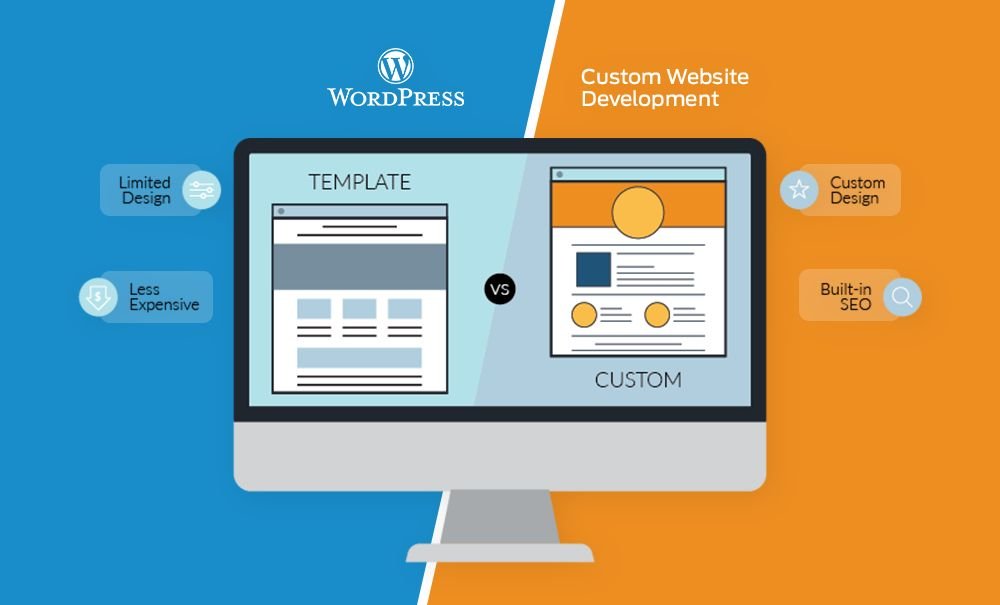
WordPress vs Custom Development: Which Is Right for Your Dubai Business in 2026?

Most Dubai business owners approach this decision backwards. They hear "WordPress is cheaper" or "custom is better" in a sales call, choose accordingly, and discover a year later that the platform was wrong for their situation. The business that chose WordPress to save money is now paying a developer every time they need a basic update. The business that chose custom development to look premium is stuck with an unmaintainable codebase because the original developer has moved on.
Neither platform is universally right. Both are right for specific situations — and those situations are more predictable than most guides suggest. This article gives you the framework to decide clearly: what each option genuinely delivers, the security reality most agencies will not volunteer, what things actually cost in Dubai in 2026, and the scenarios where each choice is correct.
What "WordPress" and "Custom" Actually Mean in a Dubai Agency Proposal
These two terms are used inconsistently across the Dubai market, which is the first source of confusion when comparing agency quotes. Before evaluating cost or capability, you need to know exactly what each option delivers.
WordPress (CMS-Based Development)
WordPress powers over 43% of all websites globally — not by accident. It is a content management system where you manage pages, images, and blog posts through a dashboard without writing code. A developer customises a theme to match your brand, adds plugins for the features you need, and hands you a site you can update yourself. A well-executed WordPress build is a professional product. It is not a second-tier compromise. Most Dubai service businesses, professional practices, and SMEs are genuinely better served by a properly built WordPress site than by the custom alternative.
What varies is quality of execution. A developer who installs 25 poorly chosen plugins, uses a cheap template, and hands the site over with no security configuration is not delivering the same product as one who builds a clean, lean WordPress installation on managed hosting with a sensible AMC in place. The platform is the same. The outcome is completely different.
Dubai cost range: AED 7,000–35,000 for a professional SME build. AED 3,000–7,000 exists but typically delivers template-only work with limited customisation.
Custom Development
A custom website is built from scratch using programming frameworks — React, Next.js, Laravel, or similar — without relying on a CMS template or plugin ecosystem. Every feature is purpose-built for your specific requirements. The key trade-off is not just cost: it is dependency. A custom-built site requires its original developers, or equivalently skilled ones, to make any structural change. If that development relationship ends, you may inherit an unmaintainable codebase.
Dubai cost range: AED 25,000–120,000 for a business-grade custom build. AED 120,000–300,000+ for complex web applications, platforms, and enterprise systems.
The WordPress Security Reality in 2026
This is the section most agencies skip in their sales process. The security landscape around WordPress has changed significantly — and Dubai business owners who choose the platform deserve an honest picture of what ongoing security management actually requires.
According to Patchstack's State of WordPress Security 2026 — the authoritative annual report from the leading WordPress vulnerability intelligence provider — 11,334 new vulnerabilities were discovered in the WordPress ecosystem in 2025, a 42% increase from 2024. Highly exploitable vulnerabilities rose 113% year-on-year. The median time from a vulnerability being made public to the first active exploit in the wild was five hours.
The source of virtually all these risks is third-party plugins, not WordPress core itself. Plugins accounted for 91% of all vulnerabilities. More alarming: 46% of newly discovered vulnerabilities were not patched before they were publicly disclosed — meaning nearly half of all new security gaps became known to attackers while the affected plugin remained open to attack. Patchstack's own conclusion: "Regular plugin updates are the second line of defence, but as attackers weaponize new vulnerabilities within hours, this is not a viable defence on its own."
Custom development carries a smaller attack surface precisely because there is no third-party plugin ecosystem to exploit. But custom code is not inherently secure — poorly written custom code introduces its own vulnerabilities. The difference is that custom vulnerabilities tend to be site-specific rather than mass-exploited simultaneously across hundreds of thousands of installations sharing the same plugin.
The Full Cost Comparison: Build Price Is Only the Starting Point
The most common mistake in this decision is comparing build quotes in isolation. The true financial comparison is total cost of ownership over three years — including the ongoing costs that rarely appear in an agency's opening proposal.
| Cost Category | WordPress — Professional Build | Custom Development |
|---|---|---|
| Initial build (Dubai SME) | AED 7,000 – 35,000 | AED 25,000 – 120,000+ |
| Hosting (annual) | AED 1,200 – 3,600 Managed WP hosting |
AED 3,600 – 12,000+ VPS or cloud server |
| Plugin licences (annual) | AED 1,500 – 4,000 5–8 core plugins |
None |
| Security layer | AED 800 – 2,400/yr WAF + scanner (non-negotiable in 2026) |
Built into build cost or included in hosting |
| Annual maintenance (AMC) | AED 2,000 – 8,000 Updates, backups, monitoring |
AED 6,000 – 24,000+ Developer retainer required |
| Content updates | Free — client manages via dashboard | AED 200 – 600/hr developer time |
| Approx. year-1 total (mid-range SME) | AED 14,000 – 55,000 | AED 40,000 – 160,000+ |
| Approx. 3-year total | AED 25,000 – 90,000 | AED 70,000 – 220,000+ |
The cost advantage of WordPress is real and substantial — but it is not unconditional. If your business needs frequent development changes, complex integrations that no plugin adequately handles, or custom business logic, the cost advantage narrows quickly as you pay developer time for customisation work. The "cheaper" platform becomes expensive when it is the wrong fit for your requirements.
The Decision Framework: Matching Platform to Business Situation
The question is not "which platform is better?" It is "which platform is better for my specific situation?" Most businesses that have made the wrong choice did so because they answered a general question instead of a specific one. The following framework maps business scenarios to platform recommendations.
✓ Choose WordPress when:
- You need a professional site live within 4–8 weeks
- Your team will manage their own content — blog posts, service updates, team pages — without developer involvement after handover
- Your features are well-served by mature, reputable plugins: contact forms, booking systems, basic e-commerce, bilingual Arabic/English, SEO management
- Your build budget is AED 7,000–35,000 and you want professional results within that range
- You are a service business, restaurant, hotel, professional practice, or SME that needs a high-quality, maintainable website without custom engineering
- You plan to run a content marketing or SEO strategy — WordPress's content management and SEO plugin ecosystem is purpose-built for this
✓ Choose Custom Development when:
- Your core business functionality cannot be replicated by any existing plugin — a proprietary booking workflow, a custom product configurator, a specific client portal with unique business rules
- You need enterprise-level performance: the site will handle 100,000+ monthly visitors, process complex transactions, or integrate deeply with your ERP or CRM
- You have a dedicated development team or a long-term agency retainer — custom code without ongoing developer support is a liability, not an asset
- Your competitive advantage is the digital product itself — a tech startup, a fintech application, or a SaaS platform where the website IS the business
- Security or compliance requirements prohibit running third-party plugins — specific regulated financial services, government-adjacent projects, or high-value e-commerce platforms handling sensitive data at scale
- Your build budget comfortably exceeds AED 50,000 and you have budget for ongoing development
Running WordPress Safely: What Your AMC Must Cover in 2026
If your situation points to WordPress — which is the right answer for the majority of Dubai SMEs — the security data above should inform your maintenance brief, not discourage the choice. A properly configured, actively managed WordPress site is a professional and viable product for most business needs.
The critical word is actively managed. Given that the median time from vulnerability disclosure to active exploitation is now five hours, any maintenance approach that relies solely on periodic plugin updates is insufficient. Here is what a credible WordPress AMC must include in 2026:
- Managed hosting with server-level security — not cheap shared hosting. Managed WordPress hosting providers include automated malware scanning, server-side firewalls, and daily backups as standard. This is the single most impactful security decision you make.
- Web Application Firewall (WAF) — blocks exploit attempts at the network layer before they reach your WordPress installation. Essential given the five-hour exploitation window.
- Automated vulnerability monitoring — a service that alerts your agency the moment a vulnerability is disclosed in any plugin your site runs, not after the next scheduled update check.
- Minimal plugin footprint — every plugin is a potential attack vector. A properly built WordPress site needs 8–12 vetted plugins, not 25. Ask any agency proposing your build how many plugins they intend to use and why.
- Regular backups with tested restore — daily backups stored off-server. A backup that has never been tested is not a backup.
- Defined update SLA — your AMC should specify how quickly critical plugin updates are applied. Given the exploitation timeline, "whenever we get to it" is not an acceptable answer.
To check your own site's performance and security baseline right now, run a free audit at pagespeed.web.dev for Core Web Vitals, and log into Google Search Console to review any security flags or indexing issues. These two free tools give you an immediate picture of how Google sees your site today.
One Scenario That Changes Everything: Losing Access to Your Own Site
Whether you choose WordPress or custom development, the single most important clause in any web project agreement is who owns the finished product. This is where Dubai businesses get caught out far more often than the platform choice itself.
Your website files, database, domain registration, and hosting account must be owned and controlled by your business — not your agency. Any agreement where the agency holds the hosting account, retains ownership of the codebase, or controls the domain registration creates leverage over you that becomes very expensive to exit. Before signing any web development contract, confirm in writing that all assets transfer to you on project completion, and that you can move hosting, change agencies, or access your own files independently at any time.
This applies equally to WordPress and custom builds. The platform does not protect you from a bad ownership structure.
Key Takeaways
- WordPress is the right choice for most Dubai SMEs — professional practices, service businesses, restaurants, retail brands, and content-driven companies. The 43% global market share is not coincidence; it reflects genuine fitness for these use cases. The platform is not the risk. Unmanaged implementation is.
- Patchstack's 2026 security report documented 11,334 WordPress ecosystem vulnerabilities in 2025 — a 42% increase year-on-year — with a median five-hour window from disclosure to active exploitation. A WordPress AMC in 2026 must include managed hosting, a WAF, automated vulnerability monitoring, and a minimal plugin footprint. Periodic updates alone are not a sufficient security posture.
- Custom development is correct for complex platforms, SaaS products, enterprise integrations, and businesses where the digital product itself is the competitive advantage. It is not the right choice for most SMEs, and it carries a hidden long-term cost: dependency on developer availability for every change.
- The three-year total cost of ownership — not the opening build quote — is the correct comparison metric. WordPress typically costs AED 25,000–90,000 over three years for a mid-range SME. Custom development typically costs AED 70,000–220,000+. The gap is real and justifiable when custom is genuinely required. It is not justifiable when it is chosen for prestige rather than necessity.
- Regardless of platform: confirm in writing that your business owns the domain, hosting account, files, and codebase on project completion. This single clause prevents the most common and costly outcome of a web project gone wrong.
Sources Referenced in This Article
- Patchstack — State of WordPress Security in 2026 (11,334 vulnerabilities, 42% increase, 5-hour exploitation window, 46% unpatched at disclosure)
- The Repository — Patchstack 2026 WordPress Security Report Analysis (91% plugin source, exploitation timeline analysis)
- Prontosys IT Services — Website Design Price in Dubai 2026 (Dubai cost ranges: AED 3,000–300,000)
- Beta Soft Technology — WordPress Development vs Custom Website: Pros, Cons & Differences 2026
- Idrisoft Solutions — Custom Website vs WordPress 2026: Cost, Speed & ROI
- AK Web Services — WordPress vs Custom Website: Which Is Better for UAE Businesses? 2026
- Digital Marketing Sage — WordPress vs Custom: The Definitive 2025/2026 Guide
- CMSMinds — WordPress vs Custom Website: Which Is Best for Your Project?
Not Sure Which Platform Fits Your Business?
Wisdom IT Solutions builds both WordPress and custom websites for businesses in Dubai and the region. Tell us what your site needs to do — we will give you a clear, unbiased recommendation and an honest cost estimate before any commitment.
Get a Free Platform ConsultationYou may also like
Arabic and Bilingual Website Design for Dubai Businesses: Why Translation Is Not Localisation